Showing posts with label Kennedy Administration and Vietnam war. Show all posts

Monday, August 12, 2024

The Folly of US Involvement in the Vietnam War: Quagmire and Betrayal

 Wayne Harmon enlisted in the Marines right out of Dominquez High School in Compton, California in 1966. He became one of the 60,000 American servicemen killed in action in Vietnam.  Just 21 years-old, one of two children and the only son.  He was also my neighbor.  Wayne was a member of Company H, 2nd Battalion, 9thMarines.  The Virtual Wall (VirtualWall.org) of the Vietnam Veterans Memorial has this summary of the fierce battle that he took part in which resulted in his death on 15 May 1967: 


In the spring of 1967, NVA forces based in and supplied from the DMZ were conducting major operations from Khe Sanh in the west to the coast. On 24 April a major battle bagan at Khe Sanh, NVA forces repeatedly cut Highway 9 between Cam Lo and Khe Sanh, and initiated major mortar, rocket, and artillery attacks against Marine installations at Gio Linh, Camp Carroll, and Dong Ha. At 0300 on 08 May the NVA staged a major effort against the Marine observation post on Hill 158 at Con Thien, two miles south of the DMZ's southern border, with simultaneous diversionary attacks against Camp Carroll, Gio Linh, and Dong Ha. Although the elements of 1st Bn, 4th Marines, held out at Con Thien, they lost 44 men killed and 110 wounded. On 10 May a Marine A-4E (BuNo 151997) was hit by surface-to-air missiles fired from just north of the DMZ; the pilot, Major Robert L. Snyder, was killed in the incident.”


The Virtual Wall summary just described here lists all the Marine units involved and the casualties by unit.   In my reading, I counted no less than 238 Marines KIA and 1,549 wounded.  This was a serious and vicious battle.  The North Vietnamese Army (NVA) amassed a large force, and a fierce battle began with high powered weapons.  This, in a way, was a foreshadowing of what was to come in February of 1968 with the NVA’s Tet Offensive, an equally brutal battle.  The American historian, Mark Bowden, in his bookHuè 1968: A Turning Point of the American War in Vietnam describes this historic battle in detail.    Both battles were won by US forces, but the price was huge in men killed and wounded, a Pyrrhic victory.  US forces won all battles with the enemy, but this was not enough, for the enemy was never defeated.  They lost all engagements, but their strategy was to endure and wear out the Americans; indeed, they did eventually.  Time was on their side.  Eventually Americans and politicians became weary; first they pulled out all US forces and then reneged on our promises from the Paris Peace Accords to resupply South Vietnamese forces.  The end came quickly in 1975.  This was something JFK’s Whiz Kids advisers did not foresee nor were they capable of understanding.  We paid a heavy price:  60,000 killed in action and another 300,000 wounded; not to mention all the money spent on the war.  It is estimated that the United States spent nearly one trillion dollars in 1960s money on the Vietnam war: the equivalent of eight trillion dollars in today’s money.   A lot of falsehoods have endured about the Vietnam war.  Here is a terrific five-minute video by Bruce Herschensohn explaining what really happened:  Click here to view it.


How did we get involved in this war?  Why?  These are questions that are still asked.  A new book written by Charles Trueheart, the son of the Assistant US Ambassador to Vietnam in 1961, Bill Trueheart, called  “Diplomats at War:  Friendship and Betrayal on the Brink of the Vietnam War” is revealing.   Trueheart was a 10-year-old when he accompanied his father to Saigon in 1961.  This book gives a personal view of everyday happenings, the characters involved and the sheer madness of what the US administration of President Kennedy was up to.  If you dislike politicians, you will absolutely despise these guys.  They were green bureaucrats, uninformed, arrogant, full of themselves and mindless, with my apology to people with disabilities.  The blind leading the blind.  I would call them The Not Ready for Prime-time Players.  JFK was no different.  Led by Averell Harriman, Bobby Kennedy, Dean Rusk and the former Ford Motor Company executive, Robert McNamara, JFK’s Secretary of Defense.  None had any experience in Southeast Asia, its culture or its people, nor any knowledge of world affairs for what they were about to, unknowingly, design.  McNamara’s background was in economics and management. He resigned in 1967 and admitted his failures.  Click here for a related story. It was too late to reverse the course of the war.  McNamara’s son, Craig McNamara, wrote a book about his father’s role in Vietnam called Because Our Fathers Lied: A memoir of Truth.”   McNamara was a disaster as a defense secretary.  Check out this article on the damage he did to the Strategic Air Command.  Click here.


Of all the characters in this sad and tragic story, one person stands out:  Averell Harriman.  The ex-Governor of New York, Harriman was arrogant, self-deluded, abrasive and a generally nasty person.  JFK idealized him.  Harriman was also very wrong on everything he was involved with.  Harriman badly wanted to be Secretary of State.  Instead, JFK appointed him as Assistant Secretary of State for Far East Affairs. He probably did not know where the far east was unless he looked at a map. Trueheart tells the story of a cabinet meeting with the Ambassador of South Vietnam, Fritz Nolting.  While Nolting was speaking, Harriman yells at him and tells him “Shut up, nobody wants to hear from you,” in front of the President and other cabinet members.  JFK rebuked Harriman and said “I want to hear what he has to say.  In a 1976 interview with Harriman’s biographer, Rudy Abramson, Nolting says this: “Nobody, in my opinion is as directly responsible for that disaster as Averell Harriman.” That disaster is referring to is Vietnam (p298).


Another excellent book on this subject dealing with the early years prior to, and the early stages of the war, is “The Lost Mandate of Heaven, The American Betrayal of Ngo Dinh Diem President of Vietnam.” By Geoffrey Shaw.  I have another blog post based on this book:  Click here to read it.   This book deals with the same mistakes described here.  Shaw describes in detail the role that the media played and how they were so influential on US politicians and public opinion about the war.  David Halberstam, the influential New York Times reporter and Walter Cronkite, the stately professorial looking CBS News Anchorman had a lot of influence on the rest of the media as well as public opinion.  Halberstam was a green 27-year-old journalist with an eye on shaping the narrative about Vietnam; a narrative that the NY Times promoted.  Most of it was negative. As it turned out, they were right. Trueheart tells the story of French journalist François Sully who was once asked by the US Ambassador why he always looked at the hole in the donut in his reporting about happenings in Vietnam?  Sully responded:  Because, Mr. Ambassador, there is a hole in the donut.


There is no doubt that the Kennedy Administration, his advisors and functionaries colored the reality on the ground, and in some ways disguised the truth, i.e., lied.  I recall that the administration promoted the body count; the number of enemy killed, as a way of showing the progress of the war.  Journalists were, in some cases, expelled for unfavorable reporting of the reality on the ground, such as François Sully, the French reporter and the NY Times reporter who preceded David Halberstam. 


The Spanish/American philosopher George Santayana coined the phrase: “Those who forget their history are condemned to repeat it.”  The Vietnam war was one excellent example of this famous saying.  We learned nothing from history.  We thought we were better than the others; we were arrogant, self-delusional and outright stupid when it came to what the US did in Vietnam prior to the explosion of all-out war.   I am a US Army Vietnam Veteran.  I was in Vietnam in 1968-69, the hottest year of the war and a time when we had 550,000 troops there: the highest number in the war.


As soon as the French pulled out of Vietnam after their defeat in the famous battle of Dien Bien Phu in 1954, the United States, basically became the new colonial overlords and started what they could not finish, except they were too arrogant and self-deluded to know it; thinking that they could do it better than the French.  This they did not apologize for.  They decided what they believed was needed to be done and then it was the US Ambassador’s job to get Diem to agree to it and do it.  Do what we say or else was their attitude.  Diem and his brother Nhu were murdered November 3, 1963, in a coup with the support of JFK, the CIA and the Kennedy administration.  Without US support the Vietnamese generals would have never done a coup, this is crystal clear.


 Another of the craziest idea the Americans came up with was the Strategic Hamlet Program by which people would be relocated from their villages, their homes torched, and new people would be put there to defend against the Viet Cong.  The Vietnamese were incredulous; they knew this would not work, and, in fact, it never worked.  But “father knows best;” just do what we say, after all, we’re Americans and we know better. 


 I was a huge JFK fan as a youth.  The more I learn about his failures, however, the more I believe he was incompetent and way out of his league.  In 1963 JFK worried more about being re-elected in 1964 than doing the right thing in Vietnam. He sensed that Vietnam was going to end badly for the US and considered ending the US involvement, but he wanted to wait until he was re-elected in 1964 to do it. The murder of Diem and his brother opened Pandora’s Box and South Vietnam spiraled out of control.  It was the American war now.  Every replacement for Diem was an utter failure. From 1963 to 1975 there were 12 different leaders of South Vietnam: all total failures.  Within a month of the coup, the ruling junta was itself overthrown. The North Vietnamese were shrewd; they knew how to measure US resolve; they knew that time was on their side; it was. They always pushed the right button on public opinion.  One example was the Buddhist monk’s self-immolation during the Diem regime in 1963. They figured this would galvanize public opinion against the war: It did.


Trueheart tells the story about how Saigon was being inundated with American politicians.  In December 1962 the senior US Foreign Service Officer, U. Alexis Johnson wired Washington warning them of the many Congressional delegations arriving in Saigon; they called them “codels,” exasperating the local officials.  When the administration’s leading hawks, like General Maxwell Taylor, Chairman of the Joint Chiefs of Staff and Walt Rostow, JFK’s deputy national security advisor went to Vietnam to assess the situation in 1961, they advised JFK that he needed about 8,000 US combat troops there to support the South Vietnamese forces.  When Kennedy heard this, he had to figure out how he could pull this off since the 1954 Geneva Agreement after the French withdrawal was that no more than about 600 US troops could be stationed in Vietnam.  This was never taken seriously by the US.  The troops were sent, and the American casualties started.  During the Kennedy Administration the number of US KIA was 120; it increased exponentially year after year.  


In less than three years of the Kennedy Administration two spectacular failures occurred:  The Bay of Pigs in Cuba and the start of the Vietnam War.


Concluding Thoughts


What were they thinking?  We had just finished World War II and Korea.  The French were defeated by 1954.  The colonial period was at an end.  Why get involved in another war that could not possibly be won?  Where were the clear-thinking men?   Could they not relate with the failure of the French?  We make the same mistakes, over and over.  Some examples:  Vietnam, Iraq, Afghanistan.  When will they learn?


Tuesday, November 20, 2018

Failure to Learn From History is Deadly

The Spanish philosopher, George Santayana said that those who fail to learn from history are condemned to repeat it.  The consequences are measured in the staggering loss of life.  Here are a few examples:

Napoleon invades Russia, 1812.  Among the many flaws that plagued Napoleon, and he had many, was his irrational belief that he could conquer the world militarily.  He started in his own back yard, Europe.  Not satisfied with his European conquests, he tried conquering Russia.  Of the 500,000 French troops that Napoleon sent to Russia, about 5,000 survived; Napoleon being one of them.  The Russian campaign was lost not only on the battle field but by the notorious Russian winter, which killed many soldiers.  For more details on the Russian campaign click here.  One of the hardest challenges for such an endeavor is the difficulty in supplying a huge army in such a huge territory. This proved to be one of the many fatal flaws in the campaign.  For a schematic dramatization of the French invasion click here for this YouTube video.

Hitler invades Russia, 1941.  Hitler, learned nothing from Napoleon's defeat in Russia for he repeated the same mistakes, with nearly similar results.  By 1944 the Germans were crushed in Russia, not just militarily but by the brutal Russian winters, disease  and starvation. Hitler was not the only one that did not learn from Napoleon's lesson.  Mussolini of Italy committed over 235,000 troops to the German Russian campaign with disastrous results.  Italian troops lacked the proper clothing, equipment and military resources to succeed.  The Hungarians and the Romanians contributed a similar amount of troops with the same disastrous results.  If the military resources did not succeed, the Russian winter did. In short all of the German, Italian, Hungarian and Romanian troops were doomed to death in a place they could not possibly succeed.  A terrific book on this subject is a historical novel called "The Red Horse" by Eugenio Corti, who was a surviving Italian veteran of the Russia campaign.  For a short article on the Italian catastrophe click here. The Germans alone estimate that they lost 4.3 million soldiers in Russia alone.

The Italian participation in Russia was nothing short of condemning innocent men to death for no reason.  First, the Germans never asked them for help.  They knew better.  They knew that the Italian armed forces were basically useless; badly armed, poorly trained and badly led.  The psychotic Mussolini demanded that he participate.  He was salivating at the possible territory gain after the Germans conquered Russia, so he thought; but psychotic people have never been known to think straight. He never learned the lesson of World War I.  Italy entered the war by promises it would gain territory, but even after being on the winning side it got very little territory: A small slice of Austria (the South Tyrol) and a return of the Italian city of Trieste.  All this at the price of 650,000 dead soldiers, not counting civilian deaths.  The allies basically renegaded on any promises they made to the Italians.  The Italians were basically snookered after WWI.  Again, they did not learn from history.  All told, it is estimated that of the 235,000 Italian troops sent to Russia 115,000 were killed.

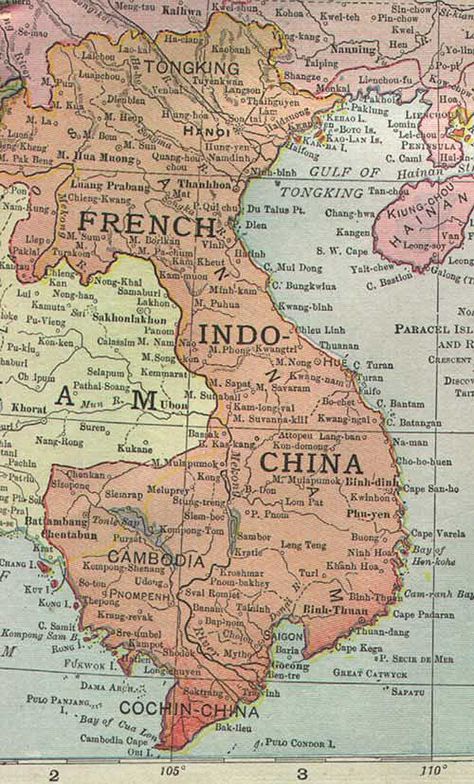
French Indochina War, 1945-54.  The French ruled what was called French Indochina, which included modern-day Vietnam, Cambodia, and Laos. The French controlled French Indochina from 1860 to 1954.  From 1945 to 1954 the French fought a war with the Viet Minh, the Vietnamese fighting for independence from France.  The Viet Minh were led by the brilliant military commander, General Vo Nguyen Giap, who later fought the Americans. The French fought brilliantly, but they were doomed from the start.  With the help of American arms, the French did all they could do but it was a losing battle. Defeat came on 8 May 1954 at the now legendary Battle of Dien Bien Phu. It is hard to get hard figures but estimates are that 500,000 Vietnamese were killed and 46,800 French troops died in the war.  In 2010 a terrific article appeared in the American weekly magazine, "The Weekly Standard" on the Battle of Dien Bien Phu.  Click here to read it. This article paints a great picture of the dire circumstances of the doomed French fighters.  At Dien Bien Phu, the French fought heroically; they gave their lives for a lost cause that should have been seen long before the war started, but again, learning from history is a lesson rarely learned.

The American War in Vietnam, 1959-1975.  I was a participant in this war from 1968-69 with the U.S. Army.  Over 59,000 Americans were killed and about 304,000 wounded in this war. With 550,000 American troops in Vietnam, the Vietnamese could not be defeated.  The Americans won most military engagements but they were all Pyrrhic victories.  As with the French, the Americans were doomed from the start.  There is a brilliant recently published book by a Canadian historian, Geoffrey Shaw, called "The Lost Mandate of Heaven."  This book details the mindless decisions made by the early U.S. Administrations of Kennedy and Johnson which basically doomed the operation before one combat soldier arrived.  The Americans refused to consider the opinions of the Vietnamese in preparing a war strategy.  The arrogance of the advisers of President Kennedy was stunning.  The biggest villain of Kennedy's advisers was Averill Harriman, the former Governor of New York.  President Kennedy is shown as incompetent and easily led by bad advice.  About half of Kennedy's advisers were correct, such as his military advisers, General Maxwell Taylor, CIA Saigon Station Chief, William Colby and his Vietnam ambassador, Frederick Nolting; Kennedy chose to follow Harriman and his acolytes into the abyss.  The seeds of destruction were planted by Kennedy between 1960 and 1963.  The fatal blow was Kennedy's support of the murder of Ngo Dinh Diem in 1963.  Following his murder South Vietnam unravelled, as his good advisers had predicted, never to recover.  As we've seen recently in Muslin countries like Iraq, once the strong leader is removed, chaos follows; this is what happened in South Vietnam after the death of Diem.  Again, if you don't learn from history, you're bound to repeat it.

Monday, July 11, 2016

How the Vietnam War was Hijacked by the Press

I recently attended a presentation by Ron Kovic at the Manhattan Beach, California Library for his new book called Hurricane Street.  Kovic is one of the best known Vietnam War critics and activist;  he is also one of the casualties of the Vietnam War.  He has been a paraplegic since 1968 when he was critically wounded in combat. The book is about Kovic's struggle with the VA in the 1970s to get adequate medical treatment for his wounds.   Steve Lopez, columnist for the Los Angeles Times, wrote a nice piece on Kovic recently.

How much does the average American know about the Vietnam war?  I would guess not very much.  A new book I just finished called The Lost Mandate of Heaven, The American Betrayal of Ngo Dinh Diem, President of Vietnam, by Canadian historian Geoffrey Shaw is a powerful testimony of how the United States got involved in Vietnam; it deals with the crucial events leading to war, from 1959 to the murder of Diem, in a 1963 coup orchestrated and sponsored by the Kennedy Administration.

As you can see by this blog, history is one of my interests.  Vietnam history is a special interest to me since I'm a Vietnam War veteran, having served in the U.S. Army in Vietnam from May of 1968 to May of 1969.  As I read "The Lost Mandate of Heaven" my anger and disgust grew exponentially.  I would close the book and scream about how incompetent President John Kennedy and his advisers were; to my wife's dismay.  A personal note: I have been an admirer of John Kennedy since 1960, and still have a picture of him in my home.  The day he was killed was one of worst days of my life. Camelot, however, became a big nightmare, as I studied the history.   Here are the main points that pop out from the book:
  • The Kennedy Administration was stacked with one of the most snobbish Ivy League elites ever, headed by the the strong-willed and arrogant Averell Harriman, a former Governor of New York, who turned out to be wrong on everything, and a complete disaster for our history.  There were wise advisers but Kennedy, himself ill informed, dismissed their advice and deferred to Harriman, a man he looked up to with a childlike wonder,
  • The Americans were totally clueless about the culture and people of Vietnam, nor did they care to learn,
  • The American press, led mainly by New York Times reporters, and by David Halberstam in particular, purposely slanted their reporting to fit their agenda and ignore all positive developments. South Vietnamese leaders bitterly complained about the negative reporting,
  • The Americans were bent on making all decisions about the war to the exclusion of the Vietnamese who knew best; to disagree with them would incur their bitter wrath,
  • The Kennedy Administration ignored the best advise from their own military and political advisers such as their ambassador in Vietnam, Frederick Nolting, CIA Saigon Station Chief, William Colby, Secretary of Defense  Robert McNamara, and General Maxwell Taylor, Head of the Joint Chiefs of Staff, as well as those who were qualified for such advice such as the British, the French and many other nations who had direct experience with the situation in Vietnam,
  • The critical event leading to the coup that killed Diem was the Buddhist uprising in the Spring of 1963, which we learned later, was incited and supported by the North Vietnamese, but promoted by the U.S. press in order to discredit Diem and get him removed from power, for which they pushed for forcefully by their negative reporting,
  • President Kennedy was more worried about his re-election in 1964 and the bad press about the situation in Vietnam than following the right advice - advice that was put to him in no uncertain  terms by top leaders of his administration and others.
The Vietnam war was lost before one American combat soldier arrived in Vietnam.  How so?  The answers are complex but let me summarize.  Strike one was the ineffective and bone-headed advice from his trusted advisers, referred to as the Harriman Group, led by the bull-headed Averell Harriman .  The Harriman Group consisted of Chester Bowles, Michael Forrestal, John Kenneth Galbraith, Roger Hilsman, Paul Kattenburg, Joseph Mendenhall, William Sullivan, and James Thomson.  Strike two was the equally uninformed and senseless Laos Neutrality Agreement signed by Kennedy in 1962, which proved to be a complete farce.  Strike three was the Buddhist uprising of 1963 which led to the military coup that murdered Diem and his brother.  This, without a doubt, was the biggest gift to the North Vietnamese.  They never foresaw being so lucky.  With Diem dead, chaos ensued and defeat was insured.  The facts are that no other South Vietnamese leader had any success as Diem had.  This was foretold by Kennedy's advisers whom he had ignored.  They had explained this very scenario.  Kennedy did not listen.  The Americans, basically shot themselves in both feet.  In the Forward to "The Lost Mandate" the author, Geoffrey Shaw,  puts it this way:  
The character of Diem is consistent, noble, and aware of the slander waged against him.  The members of the State Department - Averell Harriman, Roger Hillsman, Henry Cabot Lodge, and others are seen a vain and vindictive, ideological   and poorly informed.  Laos' neutrality was dealt with in such a way that the North Vietnamese could use the country as a conduit to bypass the northern border of South Vietnam.  This Laotian "neutrality" was the work of Harriman and made defending South Vietnam almost impossible.  North Vietnamese units came into South Vietnam.
Chapter four of the book adds this about the failed policy of the Laos Neutrality Agreement: "Kennedy's leading advocates for a new policy toward Laos had strayed into serious error.  They had believed that neutrality would succeed where arms and the best efforts of the more experienced French had been unsuccessful.  Further proof that Kennedy's men failed at what they set out to do in Laos manifested itself years later when the Americans were heavily engaged with their own forces in South Vietnam.  By then, according to Douglas Pike, the NVA totally controlled the Pathet Lao."

The Laos Neutrality Agreement was the work of Averell Harriman.  He failed to see that a signed piece of paper and reality on the ground was quite another.  Once the agreement was signed by Kennedy, Harriman met with Diem in Saigon and told him, in no uncertain terms that he must sign it.  From this meeting on both men took to a deep hate for the other.  Diem knew that this agreement was pure folly, Harriman believed that a signed piece of paper could solve the communist insurgency in Laos.  This naiveté, basically defined the whole Vietnam American experience.

From the beginning, the Americans went into South Vietnam with a smug, superior attitude, as if only they knew best how to handle the war against the Viet Cong (VC).  Diem, on the other hand, was a very savvy, cultured and revered leader of his people.  He understood his people and his culture.  The Americans, could care less.  Unless you toed their line, you were summarily dismissed and, as was the case, even murdered for not following their orders.

Just about everyone understood the value of Diem; the French, who had ruled Vietnam for centuries, realized this.  The VC certainly knew it.  Many American leaders knew this too such as Ambassador Nolting, top military leaders, Defense Secretary Robert McNamara, even Vice President Johnson. One of North Vietnamese main tools in undermining the South Vietnamese was to undermine Diem.  The preface to the book puts it this way: "Ngo Dinh Diem, possessed the Confucian Mandate of Heaven, a moral and political authority that was widely recognized by the South Vietnamese."

The U.S. news media played a huge role in destroying Diem. In Chapter two of the book, it is described like this:  "The role of the American liberal news media played in destroying the relations between Ngo Dinh Diem and the U.S. government should not be underestimated.  According to William Colby, Diem's fatal error was that he did not realize the impact of the news media."

The role of the American press cannot be overstated.  Although there were many successes in the country by the Diem government, the American press chose to give another view. The American press was staffed by young, green ideologues, such as New York Times reporter 27 year-old David Halberstam and Neil Sheehan of United Press International.  These "journalists," instead of focusing on what was going right in Vietnam, took it upon themselves to demonize Ngo Dinh Diem and accused him of corruption and being an authoritarian (seems that theses young punks knew better than the savvy Vietnamese on how to run their county. These clueless young Americans knew nothing about Vietnam).  CIA station chief, William Colby, recognized this right away as being totally wrong.

The press started causing all kinds of havoc, to the point of sabotaging the work of U.S. Ambassador to Vietnam Frederick Nolting.  Halberstam's daily drip of negative reporting seems to have mirrored the New York Times editorial line.  Halberstam, a gifted writer, began the conditioning of American public opinion which proved too much for a naive new President Kennedy, worried about his re-election in 1964.   In Chapter Eight, the author says it like this,   "Later in August 1963, Nolting's suspicions that Halberstam was catering to New York Times editorial bias were reinforced.  He received reports from a trusted colleague that Halberstam had been at the Caravelle Bar (a popular place for American reporters to congregate) "proudly displaying a telegram from his newspaper in New York, which said in substance: "Good going. Keep it up.  State Department is beginning to see it our way."   In the 1960s, when there were only three TV networks, they followed the lead of the New York Times; whatever the Times said was what they presented in their nightly news.  This still happens today, although to a lesser extent.

The Buddhist Crisis of 1963 was the smoking gun that the American press needed to sabotage the American effort in Vietnam.  They seized this as the final proof that Diem was corrupt and too authoritarian and he must be removed. This crisis, it was later learned, was instigated and supported by the North Vietnamese and VC.  The North Vietnamese were very savvy about what would disturb Americans the most.  They played this crisis like a violin masterpiece.  The U.S. media fell for it, as did the Kennedy administration.  "The communists concluded that the Vietnamese president's weakest point was American reluctance to continue supporting an undemocratic leader.  They were astute enough to realize that the tail wagging the dog of U.S. foreign policy was American public opinion."  The NY Times, basically won.  They snowballed a weak administration and took over the narrative. The author continues in Chapter 10:  "The Buddhist protests therefore would seem to have been masterfully planned acts of political manipulation carefully directed at American public opinion in order to destroy U.S. policy in South Vietnam."  

With allies like the NY Times, who needs enemies?  Chapter 10 of the book continues: "According to journalist John Mechlin, the American press in South Vietnam during the Buddhist crisis had been guilty of inaccurate or even biased reporting.  In a scathing article (September 20, 1963) that led to the protest resignation of Charles Mohr, its chief correspondent for Southeast Asia, Time asserted: "the press corps on the scene is helping to compound the very confusion that it should be untangling for its readers at home...They pool their convictions, information, misinformation and grievances...The have covered a complex situation from only one angle, as if their own conclusions offered all the necessary illumination." 

To this day, the NY Times has not taken responsibility for stabbing America in the back on Vietnam.  I'm sure they think that they did America a favor.  The lives of 60,000 American dead cry out.  The lives of thousands and thousands of American soldiers like Ron Kovic, left maimed cry out.  Shame, Shame: you worked for the enemy not your country.

The price paid for the Vietnam war - American only - not including financial costs:

Dead:  58,193
Wounded: 150,000
Missing: 1,600

Vietnamese Deaths:
Military:  444,000
Civilian:  587,000